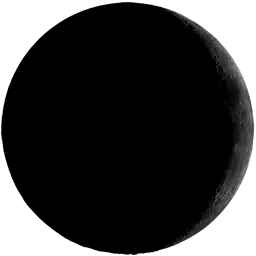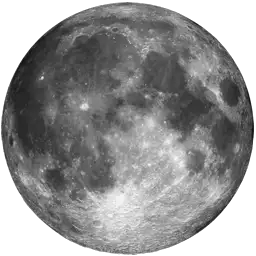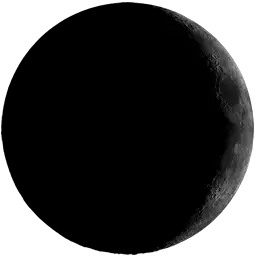
The shadow isn’t Earth’s
The Moon doesn’t shine by itself. It works like a giant, dusty mirror for sunlight – and just like Earth it always has a day side and a night side. The dark part we see is simply the Moon’s own night.
Many people think Earth’s shadow creeps across the Moon. But Earth’s shadow only reaches it during a lunar eclipse – and that only happens at full moon.
Eight phases, one orbit
From new moon to new moon takes 29.5 days on average. The cycle is usually split into eight phases, but in reality it’s a smooth change: the shadow line moves a little every hour.
 New moon
day 0
 Waxing crescent
day ~3.7
 First quarter
day ~7.4
 Waxing gibbous
day ~11.1
 Full moon
day ~14.8
 Waning gibbous
day ~18.5
 Last quarter
day ~22.1
 Waning crescent
day ~25.8
Waxing or waning?
From the northern hemisphere there’s a simple rule: if the Moon is lit on the right it is growing, if it’s lit on the left it is shrinking. The waxing Moon is seen in the evening, the waning Moon in the morning.
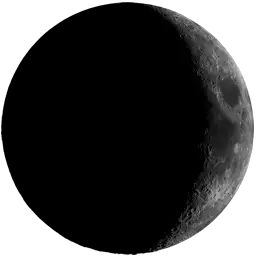 Northern hemisphereThe waxing crescent is lit on the right
Near the equatorThe crescent lies flat, like a boat
AustraliaEverything mirrored – lit on the left
29.5 or 27.3 days?
Measured against the stars, the Moon orbits Earth in 27.3 days. But meanwhile Earth has moved about 27° along its orbit around the Sun. The Moon needs just over two more days to reach the same position relative to the Sun – only then is it new moon again.
When is the Moon visible?
The phase also tells you the time of day. The full moon is opposite the Sun, so it rises roughly as the Sun sets. The new moon follows the Sun across the sky and is lost in daylight.
New moon
~06Not visible~18First quarter
~12Afternoon and evening~24Full moon
~18All night~06Last quarter
~24Night and morning~12 Waning crescent
~03Dawn in the east~15
The times are approximate and vary a lot with the seasons at high latitudes. Winter full moons ride high in the sky – summer ones barely clear the southern horizon.
“Half of the Moon is always day. We just see different amounts of it.”
Earthshine – when the dark part glows
Look at a thin crescent a few days before or after new moon: often the rest of the Moon shows as a faint, ash-grey disc. That’s sunlight that bounced off Earth, lit up the Moon’s night and bounced back to you. Leonardo da Vinci was one of the first to explain it, in the early 1500s.